How to Get a Featured Snippet: 2026 Guide
Summarize with AI
Let AI read this article and summarize the key points for you.
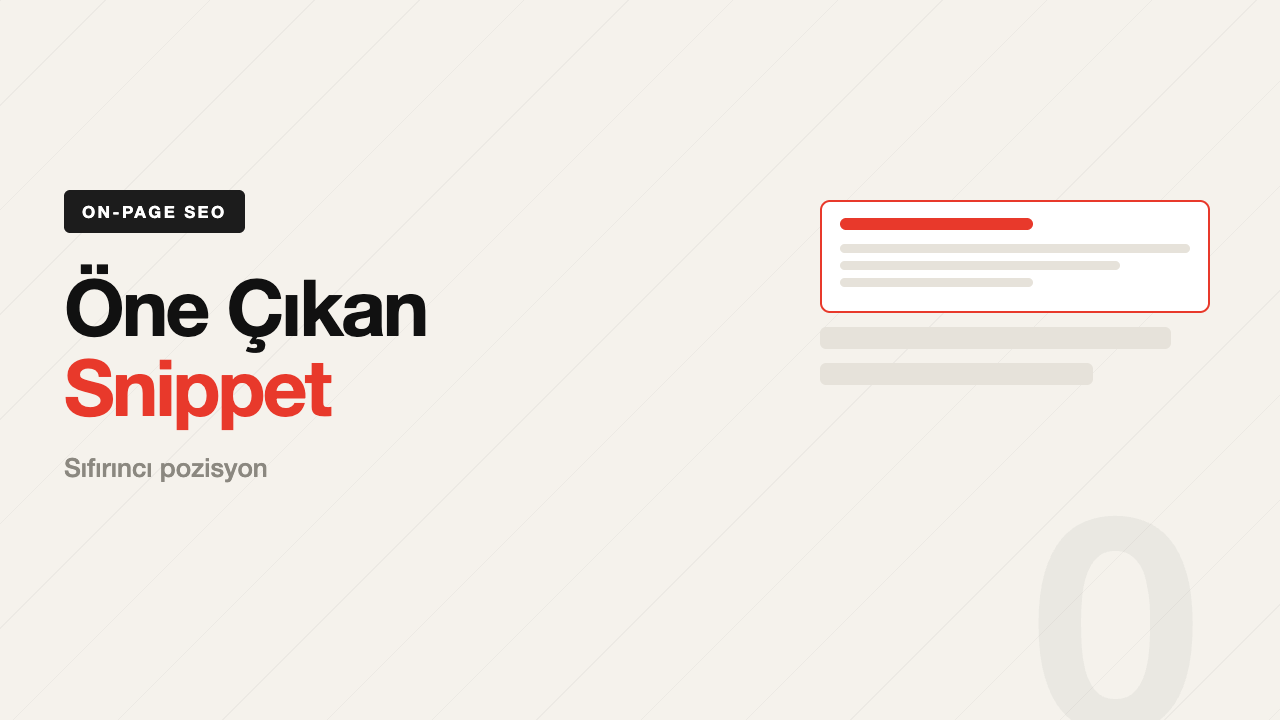
The box that sits above the search results, above even the organic listings — Google's direct answer to your question. It's called a featured snippet, known in the industry as "position zero."
In 2026, this box's value effectively doubled. Here's why: AI Overviews and chat-based search engines noticeably favor content formatted like a snippet when generating answers. So optimizing for the snippet is no longer just about Google — it's about visibility in AI-generated answers too.
Types of Featured Snippets
| Type | When it appears | How to win it |
|---|---|---|
| Paragraph | "what is," "why," "who" questions | A clear 40-60 word definition |
| List (ordered) | "how to," "steps" | Numbered steps, each one short |
| List (unordered) | "best," "types of," "examples of" | A bulleted list |
| Table | Comparisons, pricing, features | An actual HTML table |
| Video | Visual "how-to" tasks | YouTube, with timestamped chapters |
The most common by far is the paragraph type — it shows up for most query types.
The Prerequisite for Winning a Snippet
The bad news: Google pulls featured snippets almost exclusively from pages already ranking on page one. If you're not in the top 10 for a query, winning the snippet is effectively impossible.
The good news: you don't have to be #1. The page that wins the snippet is often ranking somewhere between 2nd and 8th. So you can appear above the #1 result even on queries where you can't beat it outright.
Which is why the right strategy is this: pull the queries where you're ranking between 4th and 10th and reformat those pages for the snippet. That's where the fastest wins are. Search Console → Performance → filtering for queries with an average position between 4 and 10 gives you exactly that list.
How to Format Content for a Snippet
1. Make the question a heading, answer it right underneath
The winning pattern is almost always the same:
<h2>What is a featured snippet?</h2>
<p>A featured snippet is an information box Google shows above the organic
results to answer a query directly. It pulls a 40-60 word section from your
page, paired with a title and link.</p>
The heading is the question itself, and the paragraph right after it is the direct answer. Don't insert a lead-in sentence like "In this article, we'll cover..." — the snippet crawler looks for the answer right there, and if it can't find it, it moves to another page.
2. Keep the answer to 40-60 words
The paragraph snippets Google shows typically fall within that range. Go longer and it gets truncated; go shorter and it reads as insufficient.
The answer paragraph should make sense read entirely on its own: avoid phrases that need context, like "as mentioned above" or "this method."
3. Actually number your steps
For "how to" queries, Google looks for a numbered list. Bury the steps inside a paragraph and you won't win the list snippet. Keep each step to one short sentence; put the explanation in a separate paragraph underneath.
4. Build tables as real HTML tables
Layouts that look like a table visually but are built with <div>s don't get pulled as a table snippet. Use an actual <table> tag and mark the header row with <th>.
5. Keep the pattern when defining a term
"X is a Y that ..." is the structure most often selected for definition snippets. Skip the flowery intro and open with the definition sentence directly.
Taking a Snippet From a Competitor
If a query's snippet already belongs to someone else, is it unwinnable? No — snippets change hands. The method:
- Study the current snippet. What type is it? How many words? Pulled from under what heading?
- Give the same type of answer, but better. More current data, clearer language, a more complete list of steps.
- Match the format exactly. If the current snippet is a list, give a list too — you won't take a list snippet with a paragraph.
- Move the answer higher up the page. A perfect answer buried at word 3,000 loses to a clear answer right after the intro.
- Use the query's exact phrasing. Work the way the user actually typed it ("how to get a featured snippet") into your heading.
Systematically tracking who holds the snippet for which queries speeds this up considerably; our SEO competitor analysis guide covers how to set that tracking up.
Snippets and the Zero-Click Problem
The common objection is a fair one: if the user sees the answer in the box, they won't click.
True, but not the whole story. What actually happens:
- On simple factual queries (exchange rates, unit conversions, what year something happened), the snippet really does absorb the click.
- On process and decision queries, the snippet sparks curiosity and drives more clicks — the user wants to read further.
- For brand visibility, both cases are a win either way: your name sits at the very top.
Practical tactic: give a complete but unfinished answer. Nail the definition fully, but leave the "how to apply it" part for the page itself.
The Connection to AI-Generated Answers
The work you do for snippets counts directly as GEO work. Generative search engines look at similar signals when choosing sources:
- Paragraphs that answer the question directly and read fine out of context
- A clear heading hierarchy (question → answer)
- Structured data: lists, tables, definitions
- Concrete, citable numbers
In other words, snippet format is citation format. Our what is GEO and how to appear in AI search engines articles go deeper on this.
Checklist
- [ ] Is the target query ranking on page one? (If not, fix ranking first)
- [ ] Does the query appear verbatim in the heading?
- [ ] Is the answer right beneath the heading?
- [ ] Is the answer 40-60 words?
- [ ] Does the answer make sense read on its own?
- [ ] Does the format match the current snippet's type?
- [ ] If a table is needed, is it a real
<table>? - [ ] Does the page render in the same order on mobile?
Frequently Asked Questions
How long does it take to win a snippet?
Typically a few days to a few weeks after the page is recrawled and reevaluated. Requesting reindexing in Search Console after an update can speed up the process.
Can I opt out of a snippet?
Yes. The <meta name="googlebot" content="nosnippet"> tag, or the data-nosnippet attribute, lets you keep specific sections out of snippets. Not recommended for most sites.
Can one page win more than one snippet?
Yes, for different queries. Only one snippet is shown per query.
I won a snippet but my traffic dropped — why?
The query was probably a simple factual one — the user gets the answer and leaves. For queries like that, the snippet buys you brand visibility, not clicks. Judge it by impressions and branded-search growth instead of click-through rate.
Related Articles:
Automate Your SEO
Find technical SEO errors with one click and skyrocket your organic traffic.
Automate Your SEO
Find technical SEO errors with one click and skyrocket your organic traffic.